
Short answer: most residency programs expect three letters of recommendation, and in ERAS you can assign up to four letters to each program. The strongest letters come from physicians in your specialty who supervised your clinical work, ideally in the US. Ask at least four to six weeks before you plan to apply, and give your writers your CV and personal statement.
Letters of recommendation (LoRs) are one of the most important parts of a residency application, and for international medical graduates (IMGs) US letters can make a big difference. This guide explains the ERAS rules, who to ask, how to ask, and the mistakes to avoid.
ERAS letter of recommendation rules for 2027
| Rule | What it means for you |
|---|---|
| Up to 4 letters per program | You can upload more letters to your account, but each program can receive a maximum of four. |
| New AAMC Letter Writer Portal | From the 2027 cycle, writers upload letters through the AAMC Letter Writer Portal. Writers can submit as a guest using a secure email link. |
| Specialty and program rules | Some specialties or programs ask for specific letter types, such as a chair letter or a standardized letter. |
| You request letters in MyERAS | Create each letter request in MyERAS, then share it with your writer. |
Source: AAMC ERAS for Letter Writers FAQ. Always check each program’s requirements before assigning letters.
Who should write your residency letters?
- Physicians in your chosen specialty who supervised you and saw your clinical work.
- US physicians, especially from US clinical experience (USCE). These carry extra weight for IMGs. See our USCE guide.
- Recent supervisors, ideally from the last year or two.
- A chair or program director letter if your specialty or programs ask for one.
- A research mentor can add value, but should not replace clinical letters.
A detailed letter from someone who worked closely with you is usually stronger than a short letter from a famous name who barely knows you.
How to ask for a letter of recommendation
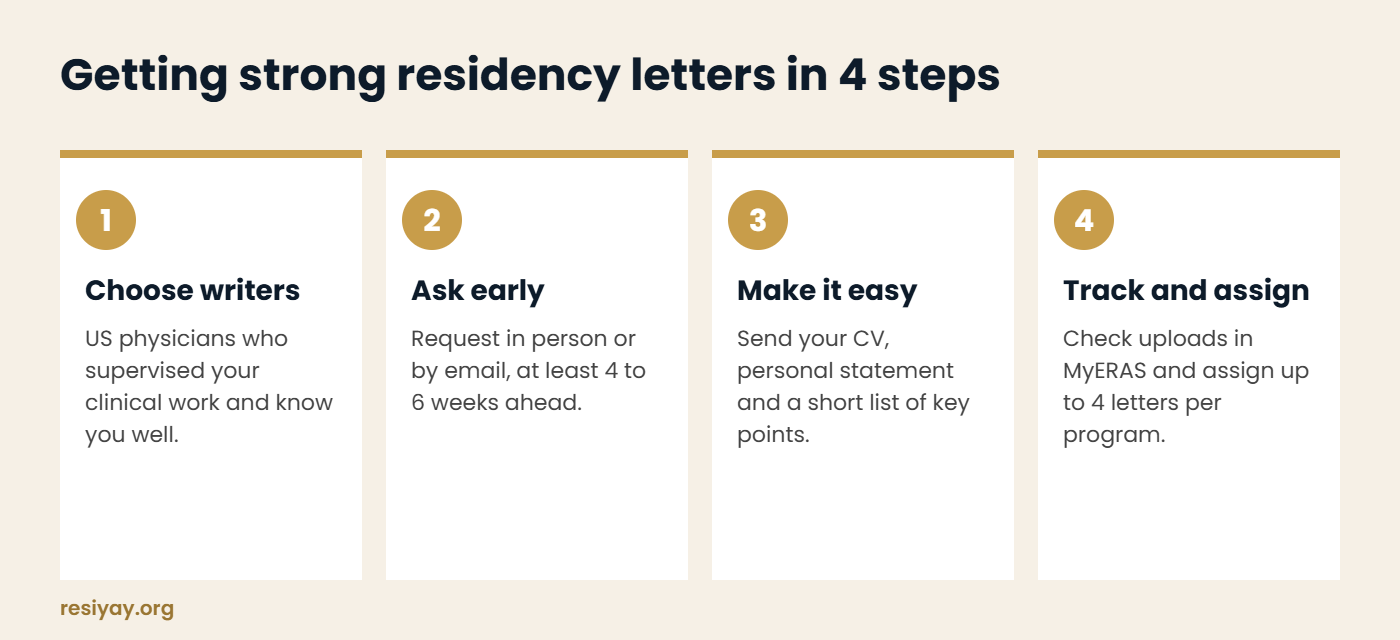
- Ask early. Give writers at least four to six weeks before you plan to submit.
- Ask directly. In person or by email, ask: “Do you feel you know my work well enough to write me a strong letter?” This gives them a polite way to say no.
- Make it easy. Send your CV, personal statement, the specialty, and a few short examples of your work with them.
- Waive your right to view the letter. Programs generally trust letters more when you have not seen them.
- Follow up politely about two weeks before your target date, and thank every writer afterwards.
Common letter of recommendation mistakes
- Asking only non-US physicians when US letters are possible.
- Asking someone who hardly knows your clinical work.
- Requesting letters too late in the season.
- Sending letters from a different specialty to every program without checking requirements.
- Forgetting to check that each letter has been uploaded and assigned.
Want your whole application reviewed?
Strong letters work best with a strong CV and personal statement. Book an ERAS CV review with a Resiyay physician advisor to make sure every part of your application tells the same clear story.
Related guides
- How to write your ERAS personal statement
- How to write your ERAS experiences section
- How to find IMG-friendly residency programs
- Residency application timeline for 2027
Frequently asked questions
How many letters of recommendation do I need for residency?
Most programs ask for three. You can assign up to four letters to each program in ERAS. Check each program and specialty for specific requirements.
Can I submit ERAS before all my letters are uploaded?
Yes. You can submit your application and assign letters when they arrive. But programs may wait for a complete application before reviewing, so aim to have letters in early.
Do non-US letters count?
They can, but US letters from physicians who supervised your clinical work are usually stronger for US residency programs, especially for IMGs.
Should I waive my right to see my letters?
Yes, in most cases. Programs generally give more weight to confidential letters.