
Short answer: in MyERAS you can list up to 10 experiences, each with a 750-character description, and mark up to 3 as most meaningful, each with an extra 300-character reflection. Choose experiences that show different strengths, describe what you did and what changed because of it, and use the most meaningful reflections to show insight, not to repeat your personal statement.
For many applicants, especially international medical graduates (IMGs), the experiences section is where program directors decide whether you are worth an interview. A clear, specific section can make an average CV look strong. A vague one can hide real achievements. This guide explains the rules, how to choose your 10 experiences, and a simple formula for writing each one.
ERAS experiences section: the rules at a glance
| Item | Limit |
|---|---|
| Selected experiences | Up to 10 |
| Description per experience | 750 characters, including spaces |
| Most meaningful experiences | Up to 3, chosen from your 10 |
| Most meaningful reflection | Extra 300 characters each |
| Impactful experiences (optional) | One response about challenges or hardships, 750 characters |
For each experience you also choose an experience type and, where relevant, a primary focus area and one key characteristic. See the AAMC MyERAS Experience guidance for the full instructions.
How to choose your 10 experiences
With only 10 slots, every entry needs a reason to be there. Aim for a balanced set that shows the qualities programs look for:
- Clinical work: US clinical experience (USCE), electives, sub-internships, externships and clinical jobs. These matter most for IMGs. See our USCE guide.
- Research and scholarly work: research roles and projects. Publications and presentations go in the separate Scholarly Work section.
- Teaching and leadership: tutoring, leading a team, organising a project or course.
- Service: volunteering, community health and work with underserved patients.
- Something personal: a skill, job or hobby that shows commitment and makes you memorable.
Related activities can be grouped into one entry to save space, for example several short volunteer roles at the same organisation.
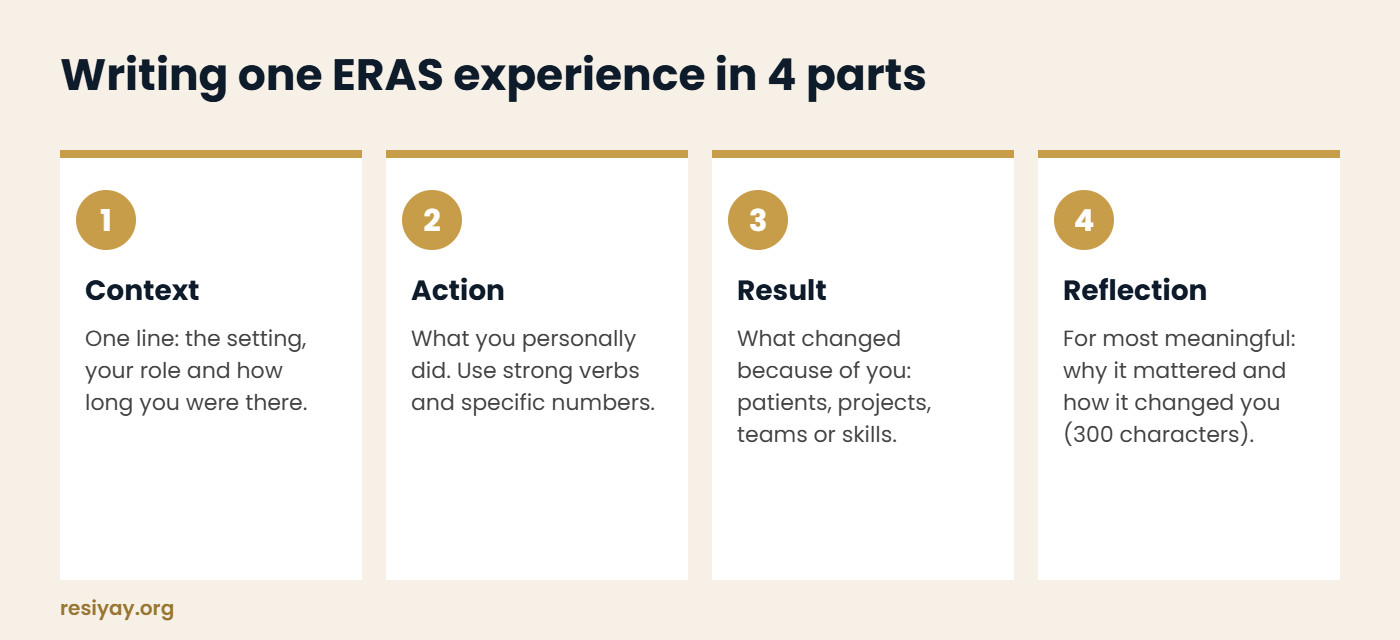
How to write each experience: context, action, result
Program directors skim. Make each description easy to read in a few seconds:
- Context: start with the setting and your role. “Research volunteer in a hospital cardiology department, 12 months.”
- Action: say what you personally did, with strong verbs: collected, presented, led, taught, managed.
- Result: show what changed because of you. Use numbers where you honestly can: patients seen, projects finished, people trained.
Weak vs strong: an example
| Weak | Strong |
|---|---|
| “Observed patients and learned a lot about internal medicine in the US.” | “Four-week inpatient internal medicine externship. Presented 3–4 patients daily on rounds, wrote progress notes reviewed by the attending, and gave a 10-minute teaching talk on hyponatremia to the team.” |
The strong version shows real responsibility, teamwork and teaching. That is what programs want to see.
How to write your 3 most meaningful experiences
Your 300-character reflection is not a summary. The AAMC asks applicants to focus on why the experience was meaningful and how it affected them. Programs are looking for introspection. Answer two questions in plain language: What did this teach me? and How do I act differently now? If you chose a key characteristic for the experience, explain why it fits.
Avoid repeating your personal statement. The AAMC suggests your reflections should not repeat what is already in your personal statement or MSPE. Our personal statement guide explains how the two work together.
Common mistakes to avoid
- Listing duties without saying what you achieved.
- Using all 10 slots for very similar experiences.
- Leaving unexplained gaps in your timeline.
- Exaggerating your role. Interviewers often ask about your CV in detail, so everything must be accurate.
- Spelling and date errors. The main application cannot be changed after you certify and submit it.
Want an expert review before you submit?
Book an ERAS CV review with a Resiyay physician advisor. We will check which experiences to include, how each one reads, and what program directors will notice first, so you can submit with confidence.
Book an ERAS CV review →
Or compare packages that include full application review
Related reading: Residency letters of recommendation: how many and who to ask · How to find IMG-friendly residency programs
Frequently asked questions
How many experiences can I list on ERAS?
Up to 10. You can choose up to 3 of them as most meaningful, each with an extra 300-character reflection.
Do I have to use all 10 slots?
No. Quality matters more than quantity. But most applicants benefit from using the space to show a range of strengths.
Where do publications go?
Publications, posters and presentations go in the separate Scholarly Work section, not in Experiences. A research job or role can still be listed as an experience.
Can I change my experiences after submitting?
No. Once you certify and submit your MyERAS application it is locked, and every program receives the same version. Check everything carefully first.