Short answer: yes, you can use AI tools like ChatGPT in your residency application, but only in a limited way. The AAMC says AI is acceptable for brainstorming, proofreading and editing your personal statement, but the final submission must be your own work. The NRMP has no AI policy, but everything you tell programs must be accurate. Use AI as an editor and practice partner, not as your writer.
AI is one of the biggest topics of the 2027 Match season. Applicants use it to draft personal statements, polish experience descriptions, write thank-you emails and practise interview questions. At the same time, programs are starting to use AI tools to help screen applications. This guide explains what the rules actually say, where AI helps, where it hurts, and how international medical graduates (IMGs) can use it without risking their application.
What the official rules say about AI in residency applications
| Organization | What it says | What it means for you |
|---|---|---|
| AAMC (ERAS) | AI is acceptable for brainstorming, proofreading or editing the personal statement, but the final submission should represent your own work. | Do not submit an AI-written statement. Use AI to improve your draft. |
| NRMP | Has not taken a stance on AI-generated content or “integrity screening” (statement of September 13, 2024). | There is no AI ban, but Match rules still require honest, accurate information. |
| NRMP Match Participation Agreement | Information you give programs must be complete and accurate. | Never let AI add experiences, skills or details that are not true. |
| Residency programs | Some programs are testing AI tools to help review applications. | Clear, specific, genuine writing matters more than ever. |
Sources: AMA: How to use AI in residency applications and the NRMP. Rules can change, so always check the latest AAMC and NRMP guidance before you submit.
Where AI genuinely helps
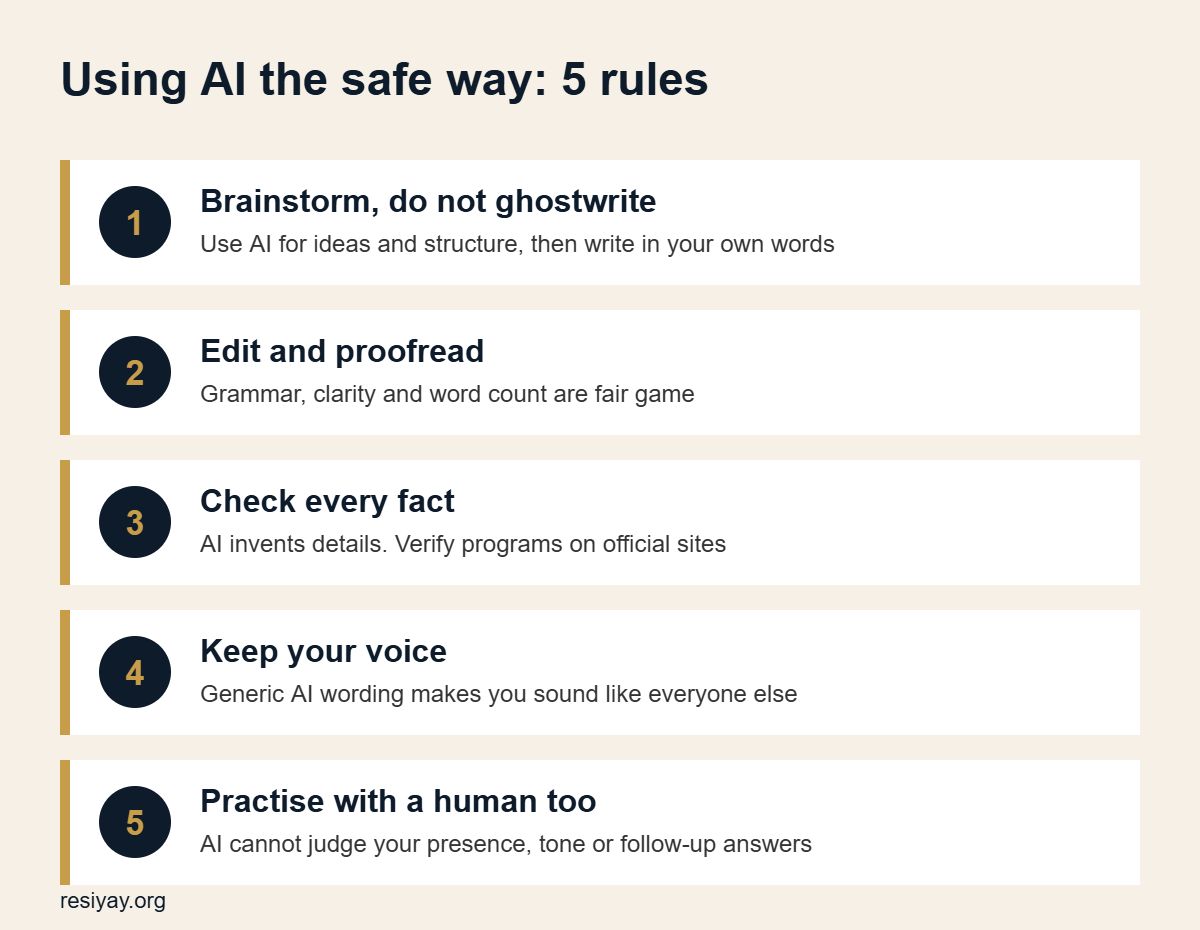
- Brainstorming: ask AI to help you list moments from your training that show resilience, teamwork or clinical growth. Then choose and write the story yourself.
- Editing for clarity: paste your own paragraph and ask for shorter sentences, simpler words or a tighter word count.
- Proofreading: catch grammar, spelling and tense errors, which matters a lot for IMGs writing in a second language.
- ERAS experiences: tighten your descriptions so they fit the character limits. See our ERAS experiences guide.
- Interview practice: generate common and behavioural questions and rehearse your answers out loud.
Where AI hurts your application
- Generic writing: AI-written statements tend to sound the same. Program directors read hundreds of them, and a statement that could belong to anyone is easy to forget.
- Made-up facts: AI can invent program details, statistics or even experiences. One wrong claim can damage your credibility, and it may break Match rules on accuracy.
- Losing your story: your personal statement is the one place programs hear your voice. If AI writes it, the person they meet at the interview will not match the paper.
- Rehearsed interview answers: memorising AI-written answers often sounds robotic, and interviewers quickly notice when you cannot go beyond the script.
How to use AI for residency interview preparation
AI is a useful first step for interview prep, especially early in the season. Use it to:
- Generate likely questions for your specialty and for IMG-specific topics such as visa, gaps or attempts.
- Practise in voice mode so you get used to speaking, not just writing.
- Ask for feedback on structure: did you answer the question, give a specific example and end with what you learned?
- Prepare questions to ask each program.
But AI cannot fully judge your tone, body language, eye contact, energy or how you handle a difficult follow-up question. It also does not know what a real program director listens for. That is why the best preparation combines AI practice with at least one mock interview with a physician who has been through the Match.
Practise with a real physician, not just a chatbot
A Resiyay physician advisor will run a realistic residency mock interview, ask the follow-up questions AI misses, and give you honest feedback on your answers, presence and red-flag questions.
Book a mock interview →
Or get your ERAS CV reviewed by a physician
Safe AI prompts you can use
- “Here is my paragraph. Fix grammar and make it clearer, but keep my words and meaning.”
- “Cut this experience description to under 300 characters without adding anything new.”
- “Ask me 10 behavioural residency interview questions for internal medicine, one at a time, and tell me if my answer was specific.”
- “What questions could a program ask an IMG about a gap in training?”
Avoid prompts like “write my personal statement” or “write a letter of intent to my top program”. The result will not be your work, and it will rarely sound like you.
Can residency programs detect ChatGPT?
Online AI detectors are not reliable, and research suggests they often get it wrong. But that is the wrong question. Programs do not need a detector to notice a statement that is vague, overly polished or does not match how you speak at the interview. The safer goal is simple: write it yourself, use AI to improve it, and make sure every sentence is true and specific to you.
Related guides
- How to write your ERAS personal statement
- Mock residency interviews for IMGs
- Residency letters of intent and thank-you notes
- Free residency interview preparation resources
Frequently asked questions
Is it allowed to use ChatGPT for my ERAS personal statement?
Yes, for brainstorming, proofreading and editing. The AAMC says the final personal statement should represent your own work, so do not submit text that AI wrote for you.
Does the NRMP have a rule on AI?
No. The NRMP has said it has not taken a stance on AI-generated content. But the Match Participation Agreement still requires the information you give programs to be complete and accurate.
Can I use AI to write my thank-you emails or letter of intent?
You can use it to check grammar and tone, but write the content yourself. Program-specific details should come from your own interview day, and any statement about how you will rank a program must be true.
Is AI mock interview practice enough?
It is a good start, but not enough on its own. AI cannot fully judge tone, presence or how you handle follow-up questions. Combine it with at least one mock interview with an experienced physician.
Do residency programs use AI to screen applications?
Some programs are testing AI tools to help review applications, and their use is likely to grow. That makes clear, specific and genuine writing even more important.