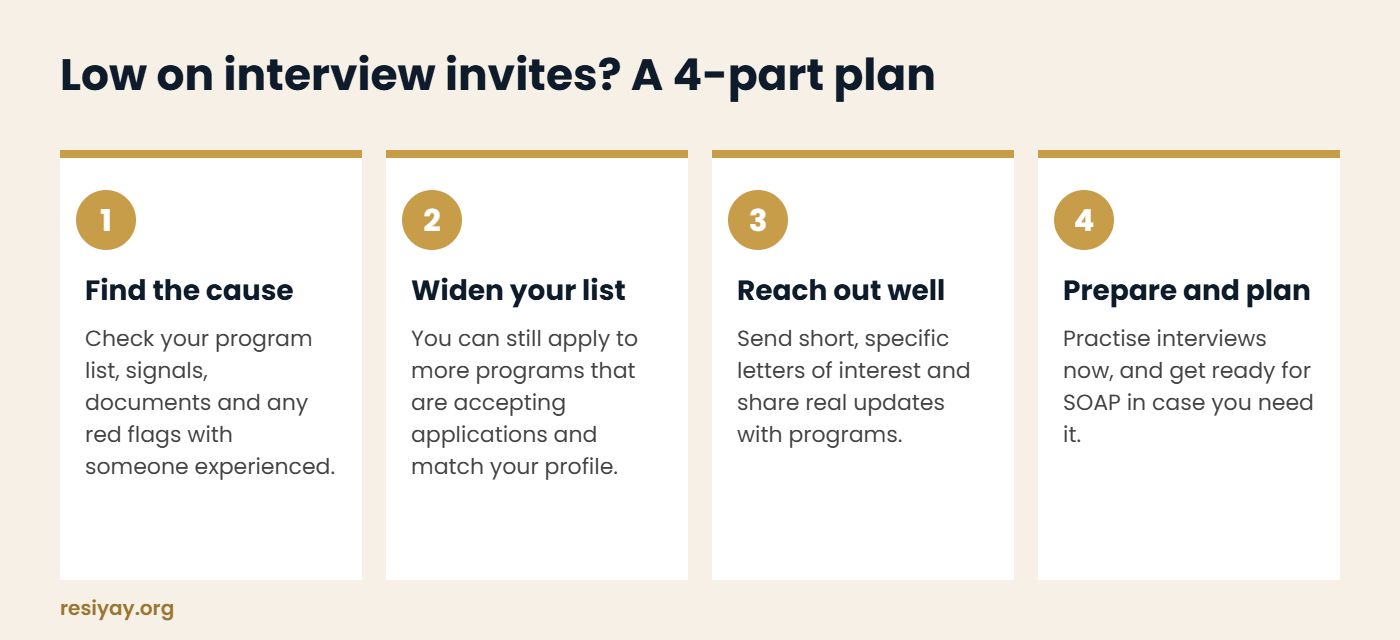
Short answer: do not panic and do not wait. Interview invitations keep arriving through the winter, but if you have few or none by November, act now: get an honest review of why, apply to more programs that fit your profile, send short and specific letters of interest, keep practising for interviews, and prepare for SOAP in case you need it.
November is one of the hardest months of the Match for many applicants, especially international medical graduates (IMGs). Friends are posting interview invites while your inbox stays quiet. The good news is that there is still time to improve your chances. This guide sets out what you can still change after submitting ERAS, what you cannot, and a practical plan for the rest of the season.
First, find out why invites are low
Before you spend more money on applications, look for the cause. Common reasons include:
- Program list: applying mostly to programs that rarely interview IMGs, or that do not sponsor your visa.
- Filters: exam attempts, year of graduation or limited US clinical experience (USCE) that falls below many programs’ cut-offs.
- Application content: experiences that are hard to read, a generic personal statement, or weak or missing US letters of recommendation.
- Specialty choice: applying only to a specialty that is very competitive for your profile, with no back-up.
- Timing: submitting late in the season, after many programs had already sent most of their invitations.
It is hard to judge your own application. An experienced reviewer can usually spot the main issue in one session. Resiyay offers an ERAS CV review and a residency strategy consultation with physician advisors who have been through the Match themselves.
What you can still change after submitting ERAS
| Part of your application | Can you change it now? |
|---|---|
| Main MyERAS application (experiences, education, publications) | No. It is locked once certified and submitted, and every program receives the same version. |
| Personal information (email, phone) | Yes, you can update it. |
| Programs you apply to | Yes. You can apply to more programs during the season, as long as they are still accepting applications. |
| Letters of recommendation | You can assign newly uploaded letters to programs, including ones you have already applied to. |
| Personal statement | You cannot edit a statement already sent, but you can create a new one and assign it to programs you apply to next. |
Source: AAMC MyERAS guidance. Check the AAMC website for current rules.
Step 1: Apply wider, but apply smarter
Adding programs late can still help, but only if they are realistic for your profile. Look for programs that have recently interviewed or matched IMGs, that sponsor your visa, and whose requirements you meet, such as graduation year and exam attempts. Twenty well-chosen programs are worth more than eighty random ones. If your main specialty is very competitive, consider applying to a second specialty too.
Step 2: Send letters of interest and real updates
A short, specific letter of interest can bring your application back to a reviewer’s attention. Keep it to a few sentences: why that program, a genuine connection (location, patients, a faculty member’s work), and one or two strengths. Follow each program’s instructions, and do not email programs that ask applicants not to.
If you have a meaningful update, such as a new publication, a new US letter, or a newly passed exam, share it briefly. Our guide to letters of intent and thank-you notes covers post-interview messages too.
Step 3: Be ready for the invites that do come
Invitations can arrive at short notice, sometimes with only a few days to prepare. Practise now so you can accept quickly and perform well. Join a free group mock, read our mock interview guide for IMGs, or book a one-to-one mock interview with a physician advisor.
Step 4: Plan for SOAP and for next year
- Register for the NRMP Match if you have not already. The standard registration deadline is January 29, 2027.
- IMGs: make sure you meet ECFMG verification requirements by March 3, 2027, the rank order list deadline.
- Certify a rank order list with every acceptable program you interviewed at. See our rank order list guide.
- Prepare for SOAP: have your documents, personal statements and a target list ready before Match Week (March 15–19, 2027).
- Strengthen your profile: if this cycle does not work out, use the time for more US clinical experience, US letters or research before you reapply.
Want an honest review of your application?
Book a residency strategy consultation. A Resiyay physician advisor will look at your profile, program list and documents, and tell you exactly what to do for the rest of this season, and what to fix for next year if needed.
Frequently asked questions
Is it too late to get interview invites in November or December?
No. Many programs continue to send invitations through the winter, often to fill gaps when other applicants decline. Keep your phone and email notifications on and respond quickly.
Can I edit my ERAS application to fix mistakes?
Not the main application. Once certified and submitted it is locked. You can update personal information, assign new letters, create a new personal statement for future applications, and apply to more programs.
Should I email programs that have not invited me?
Yes, if the program does not ask applicants to avoid contact. Keep it short and specific, and include any genuine update. Avoid sending repeated or generic messages.
What if I do not get any interviews this year?
Prepare for SOAP if you are eligible, then make a plan for the next cycle. Applicants often succeed on a later attempt with stronger USCE, US letters and a better-targeted program list.